My kids keep asking about the planets in the solar system and how big they are and how far apart they are. And I've really struggled to explain it to them in a way that they can understand, because I personally also had trouble understanding the relative size and distance of the planets and the Sun. So I made a small app they can play with. I made it almost as much for myself as I made it for them, because it also helped me understand the distances and the sizes.
The thing I'm most surprised about is that it doesn't even really fit on a screen. So I tried to visualize this in a way that lets you slide from realistic sizes and distances to the beads-on-a-thread model of the solar system that we were all taught in school. There simply aren't enough pixels on a computer screen to even represent the largest planets in our solar system in relation to our Sun, which fascinates me.
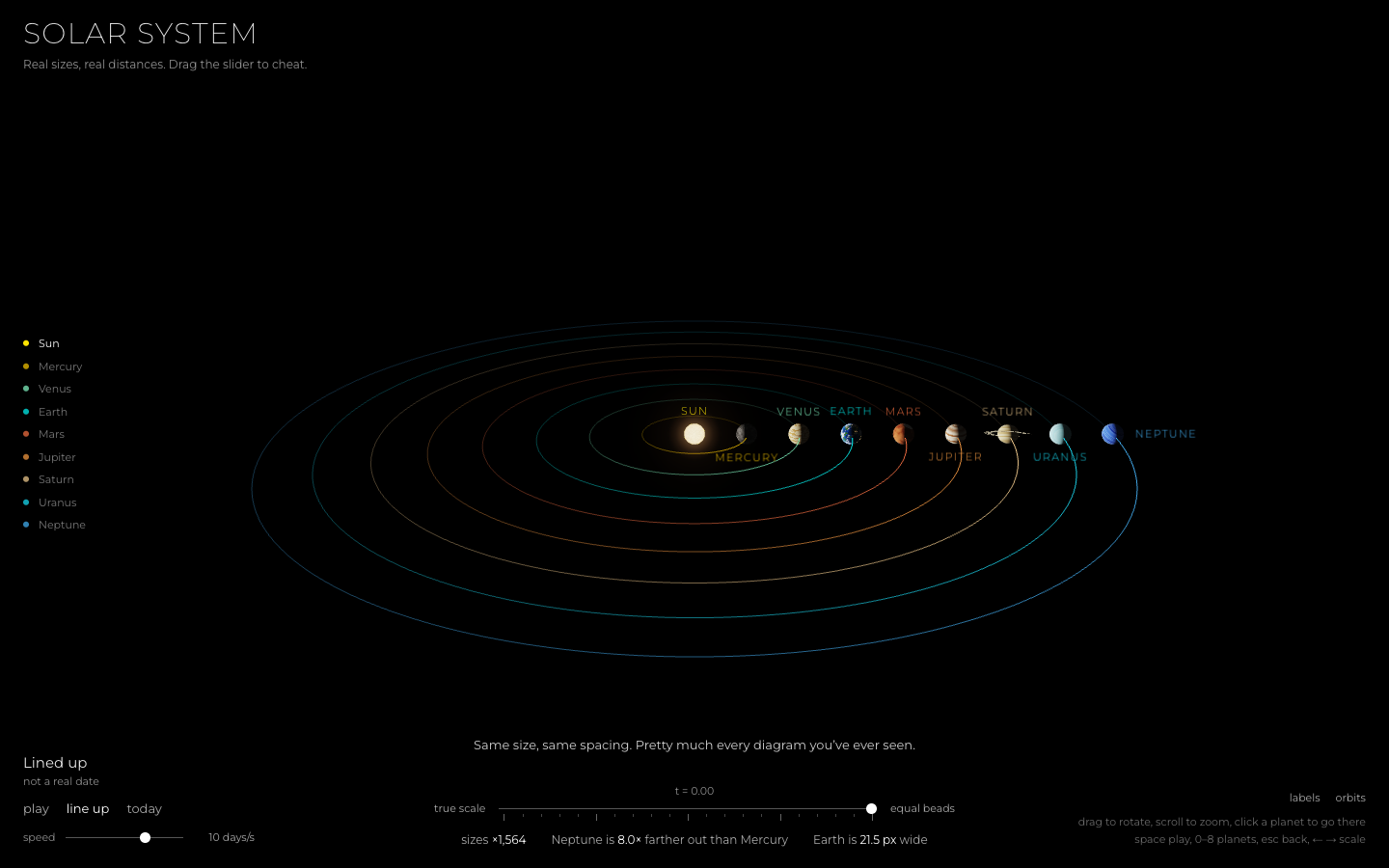
The visualization is here. You can play with it in all sorts of ways, playing the rotation of the planets around their own axes and around the Sun in real time or at different speeds, viewing the rotation of the moons around each planet and the moons' rotations around their own axes as well. And a bunch of other things.
I don't know what I'm doing here. But it was very fun to make.
How the scaling works
Every size and every distance in the app goes through the same function:
x(t) = b1−t · xrealt
where xreal is the real value (a planet's radius, or the gap between a planet and the one before it), b is the bead value that everything ends up with (the same size for every body, the same gap between all neighbors), and t is the slider. At t = 1 you get the real thing, at t = 0 you get the beads. On a log scale it's just a straight line between the real value and the bead value.
I use the same coefficient t for both sizes and distances. If you make the planets the same size but leave the distances real, Mercury, Venus, Earth and Mars end up on top of each other because they're so close together. When sizes and distances move together, nothing overlaps along the way. The moons follow the same rule around their planet.
If that doesn't make sense, that's okay. Ask me, or figure it out with an agent.